

Something Different: I Used to Dig Nagel...
 As both an artist and a collector, I found myself irresistibly drawn to Nagel’s work for its seamless blend of sophistication and suggestion. There’s a quiet power in his minimalist approach how a few deft lines and a restrained color palette can convey such depth of character. That's the technical explanation, and also at the root there's just the appreciation and then, my own animal instincts.
 My first purchase was a full size print that was from one of the Playboy collections, and it's only because I happened across it in an art gallery, before I even knew anything about him, and had only very little exposure to other pieces of his work other than some of the more prominent ones that had shown up from time to time. Bought a few other pieces here and there over time but sadly all of them were destroyed by a series of unfortunate events I'm just going to leave out of explanation.
"They say art reflects life, and I had my share of pursuing and captivating, even for a while, a handful of these dark, and seemingly brooding at times, women worthy of that inspirational work."
"Not a single regret there."
A Brief History of Patrick Nagel: Pop Art Icon and Master of Tasteful Eroticism
Patrick Nagel, an American artist born on November 25, 1945, in Dayton, Ohio, left an indelible mark on the art world with his distinctive pop art style that came to define the vibrant aesthetic of the 1980s.
Raised in the Los Angeles area, Nagel’s journey as an artist was shaped by his experiences and education. After serving in the Vietnam War with the 101st Airborne, he honed his craft at the Chouinard Art Institute and earned a Bachelor of Fine Arts from California State University, Fullerton, in 1969. His career took off in the 1970s as a freelance illustrator and graphic designer, working with major clients like ABC Television, IBM, and Universal Studios, before his signature style catapulted him to fame.
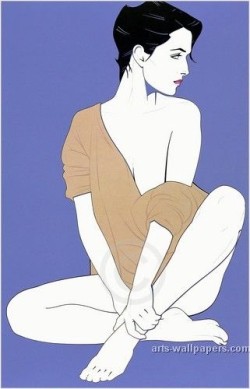
Nagel’s breakthrough came through his long-standing collaboration with Playboy magazine, where his illustrations of glamorous, stylized women often referred to as “Nagel Women” graced the pages from 1975 to 1984. These works, characterized by bold lines, minimalistic forms, and a high-contrast palette, blended the elegance of Art Deco with the accessibility of pop art.
His most iconic contribution to pop culture, however, was the cover art for Duran Duran’s 1982 album Rio, a striking image of a chic, aloof woman that perfectly encapsulated the decade’s glitz and sophistication.

Tragically, Nagel’s life was cut short in 1984 when he suffered a heart attack at age 38 during a celebrity aerobics event, but his legacy endures through his timeless artwork.
Influences Behind the Iconic Style
Nagel’s art was a fusion of diverse influences that he masterfully distilled into a singular vision. His work drew heavily from the Art Deco movement of the 1920s and ‘30s, with its sleek lines and geometric simplicity, which he updated with a modern, pop-art sensibility reminiscent of Roy Lichtenstein or Andy Warhol.
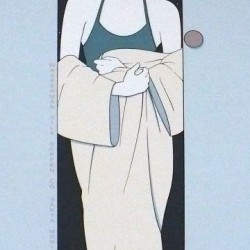
Another key inspiration was the Japanese woodblock print tradition, evident in his use of silhouetted figures against neutral backgrounds, strong black-and-white contrasts, and unconventional angles. Nagel often began his process by tracing photographs sourced from fashion magazines or advertisements then reimagining them with edits to hair, clothing, and posture to align with his aesthetic ideals. This technique allowed him to craft women who were both archetypes of beauty and enigmatic personalities, exuding confidence and mystery.
The cultural backdrop of 1980s Los Angeles, with its blend of Hollywood glamour and punk-edge modernity, also played a role in shaping Nagel’s vision. His subjects, elegant yet detached, seductive yet self-assured, mirrored the era’s fascination with material aspiration and stylish individualism. Whether illustrating for Playboy or creating standalone pieces, Nagel’s work captured a zeitgeist that resonated far beyond his lifetime.
His “Nagel Women” are not mere objects of desire; they are poised, commanding figures who seem to gaze back at the viewer with knowing confidence. This balance of eroticism and tastefulness is what sets Nagel apart. The suggestive nature of his art never feels gratuitous; instead, it invites contemplation, leaving room for imagination rather than overexposure.
From an artistic perspective, I admired Nagel’s technical precision and his ability to distill complex emotions into simple forms. His use of bold contrasts and negative space is a lesson in restraint a reminder that less can indeed be more.
The erotic aesthetic, handled with such finesse, appealed to my taste for art that pushes boundaries without crossing into the crass. It’s a rare gift to create something simultaneously provocative and refined, and Nagel’s mastery of this duality is why his work remains a treasure of my past interests.

























- Created on .
- Hits: 2141